Quick answer
A residential solar panel’s power rating is measured in watts, but the electricity it produces over time is measured in kilowatt-hours, or kWh. A 400-watt panel receiving four peak sun hours could produce about 1.6 kWh before real-world system losses. Actual output changes with location, season, roof direction, shade, temperature, panel condition and system design.
That distinction matters. The number printed on a solar panel describes its potential power under standardized test conditions. It does not promise that the panel will produce at that level throughout every daylight hour.
For a homeowner, the more useful question is not simply, “How many watts is this panel?” It is: “How much electricity could the complete solar system produce on my roof over a month or year?”
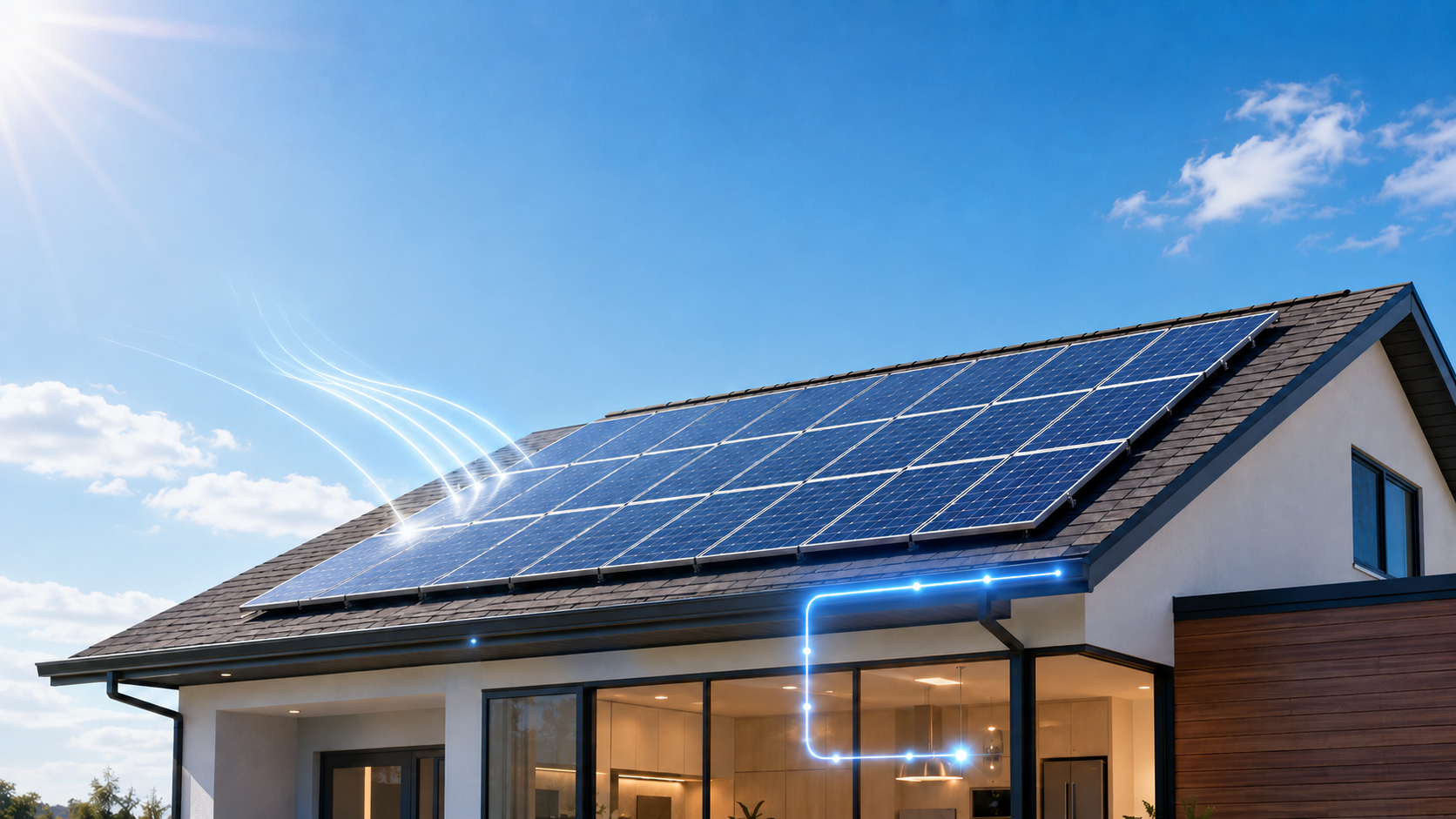
Watts
A panel’s rated power at a moment in time
kWh
The electricity produced or used over time
Annual output
The better number for comparing solar with home usage
How is solar panel power measured?
Solar output is usually described with three related measurements: watts, kilowatts and kilowatt-hours. They sound similar, but they answer different questions.
| Measurement | What it measures | Why it matters |
|---|---|---|
| Watts (W) | Power at a moment in time | Used to describe an individual panel’s rated output |
| Kilowatts (kW) | 1,000 watts of power | Commonly used to describe the rated size of a complete solar system |
| Kilowatt-hours (kWh) | Energy produced or used over time | Used on electric bills and in monthly or annual production estimates |
Think of watts as the rate of production and kWh as the amount produced over time. A panel could reach a high power level briefly without maintaining it all day. That is why panel wattage alone cannot be compared directly with the kWh shown on an electric bill.
How much electricity does one solar panel produce?
A rough daily estimate starts with the panel’s wattage and the number of peak sun hours it receives. Peak sun hours are not the same as total daylight hours. They represent the day’s solar energy expressed as an equivalent number of hours at strong, direct sunlight.
Simple production formula
Estimate one panel’s daily production
Panel watts × peak sun hours ÷ 1,000 = estimated daily kWh
Example: 400 watts × 4 peak sun hours ÷ 1,000 = 1.6 kWh before system losses.
| Example | Calculation | Estimated energy before losses |
|---|---|---|
| 400-watt panel with 3 peak sun hours | 400 × 3 ÷ 1,000 | 1.2 kWh per day |
| 400-watt panel with 4 peak sun hours | 400 × 4 ÷ 1,000 | 1.6 kWh per day |
| 400-watt panel with 5 peak sun hours | 400 × 5 ÷ 1,000 | 2.0 kWh per day |
These examples show why there is no single national answer for one panel. Even panels with the same wattage can produce different amounts of energy on different roofs or in different seasons.
The calculation is also intentionally simplified. A professional production model accounts for inverter efficiency, wiring, temperature, shade, roof geometry, panel mismatch, soiling and other losses before estimating annual output.
The decision-useful number: When comparing solar proposals, look beyond the panel wattage. Compare each system’s estimated annual kWh, the assumptions used to calculate it and how that output relates to the home’s recent electricity usage.
Panel wattage vs. real-world solar production
A panel’s rated wattage is measured under controlled test conditions. A working rooftop system operates in changing outdoor conditions. Understanding the gap helps homeowners compare solar proposals more intelligently.
| Rated panel power | Real-world production |
|---|---|
| Measured under standardized conditions | Changes with the home, weather and season |
| Expressed in watts | Usually estimated in monthly or annual kWh |
| Useful for comparing panel specifications | Useful for comparing expected output with household electricity use |
| Does not describe the complete system | Includes panel count, placement and expected system losses |
What to compare in a solar proposal: Do not stop at panel wattage or system size. Look for the estimated annual kWh production, the assumptions behind that estimate and how the projected output relates to the home’s recent electricity usage.
What affects how much power solar panels produce?
Solar production is the result of several factors working together. A higher-wattage panel can help, particularly when usable roof space is limited, but system design and site conditions remain critical.
01
Sunlight and location
Regional weather, seasonal daylight and the strength of sunlight affect annual production. Local solar conditions should be built into the estimate.
02
Roof direction
Direction changes when panels receive the strongest sunlight. Compare south-, east- and west-facing solar panels.
03
Pitch and panel angle
Roof pitch and panel placement affect how directly sunlight reaches the array throughout the day and year.
04
Shade and obstructions
Trees, chimneys, dormers and nearby buildings can block sunlight. Shade patterns can also change by hour and season.
05
Temperature and weather
Clouds, high cell temperatures, snow cover and seasonal daylight can all change daily production.
06
Equipment and design
Layout, inverter selection and electrical losses affect delivered energy. See how a complete solar system works.
How much power does a complete home solar system produce?
Whole-system output depends on the number of panels and the expected production of the complete array. For example, 20 panels rated at 400 watts create an 8-kW rated system:
20 panels × 400 watts = 8,000 watts, or 8 kW.
That 8-kW rating still does not reveal the system’s annual electricity production by itself. Two 8-kW systems can produce different annual kWh totals when one has stronger solar exposure, a more favorable layout or less shade.
| System question | Best measurement |
|---|---|
| How large is the system? | Rated kilowatts (kW) |
| How much electricity may it produce? | Estimated monthly or annual kilowatt-hours (kWh) |
| How much electricity does the home use? | Historical monthly or annual kWh from utility bills |
| How much usage may solar offset? | Estimated solar kWh compared with household kWh |
If your next question is how many panels may be needed to reach a household energy goal, use Trinity’s guide to estimating how many solar panels a home needs.
Turn a general estimate into a home-specific design
A useful solar recommendation connects three things: the home’s electricity history, the roof’s usable solar exposure and the system’s expected annual kWh.
How solar production changes throughout the day
Solar panels do not produce the same amount of electricity every hour. Output generally begins after sunrise, rises as sunlight becomes stronger, reaches its highest levels during the most favorable part of the day and falls toward sunset.
A typical daily production pattern
Illustrative only. The actual curve changes with direction, shade, season and weather.
The exact production curve depends on panel direction and shade. An east-facing section may begin producing strongly earlier in the day. A west-facing section may carry more production later into the afternoon. A system split across multiple roof planes can have a broader production curve than an array facing only one direction.
This is another reason the system’s monthly and annual energy estimate is more decision-useful than a single maximum wattage number.
Can solar panels power an entire home?
A solar system may be designed to offset a large portion of a home’s annual electricity use, but the answer depends on household consumption, available roof space, solar exposure, local requirements and the system that can realistically be installed.
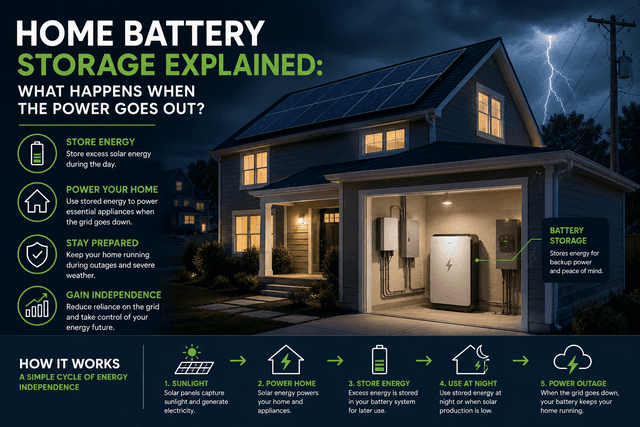
It is also important to separate annual energy offset from continuous power. A grid-connected solar system can send electricity to the home when it is producing and interact with the utility grid at other times. Solar panels alone generally do not provide backup power during a grid outage. That typically requires compatible battery storage and equipment designed for backup operation.
Homeowners interested in storing solar energy or planning for outages can explore home solar battery options. Battery capacity, protected loads and system configuration determine what can be powered and for how long.
What happens when solar panels produce more electricity than the home is using?
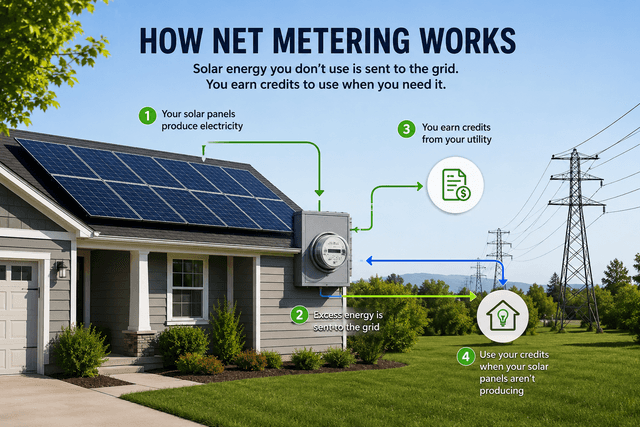
When a grid-connected system produces more electricity than the home is using at that moment, the system may send excess electricity to the grid or direct it to compatible battery storage. What happens financially depends on the utility, rate structure, interconnection agreement and applicable net-metering rules.
Those rules vary by location and can change. Homeowners should review the current program terms that apply to their utility and project rather than assuming excess electricity will always receive the same credit.
Learn more about how net metering works and which questions to ask before comparing solar options.
What should you look for in a solar production estimate?
A production estimate should connect the system design to the conditions at the home. Before treating any number as decision-ready, ask:
- Is the estimate stated in annual kWh? This makes it easier to compare projected solar energy with electricity usage.
- Does it use recent utility data? A full year of bills usually gives a stronger baseline than one unusually high or low month.
- Does it account for the actual roof? Direction, pitch, usable area, shade and obstructions can materially change production.
- Are system losses included? Nameplate wattage should not be treated as uninterrupted real-world output.
- Does it reflect future electricity needs? Planned changes such as an EV, electric heating equipment, an addition or different household use may affect the appropriate design.
Trinity’s home solar process begins by looking at the home, electricity use and project goals before developing a system recommendation. That is the point where general online calculations become a property-specific solar design.
Final thoughts: Focus on annual kWh, not the biggest wattage number
A solar panel’s wattage is useful, but it is only the starting point. The stronger comparison is how much electricity the complete system is expected to produce over a year, how that estimate was calculated and how it compares with the home’s actual electricity use.
A higher-wattage panel does not automatically create the best result for every roof. The right system balances panel output, usable space, sunlight, shade, equipment and the household’s energy goals.
See what solar could produce for your home
A Trinity Solar Expert can review the home, recent electricity use and project goals to help develop a property-specific recommendation.
Continue learning
Connect system output with household electricity use. Roof designWhat direction should panels face? →
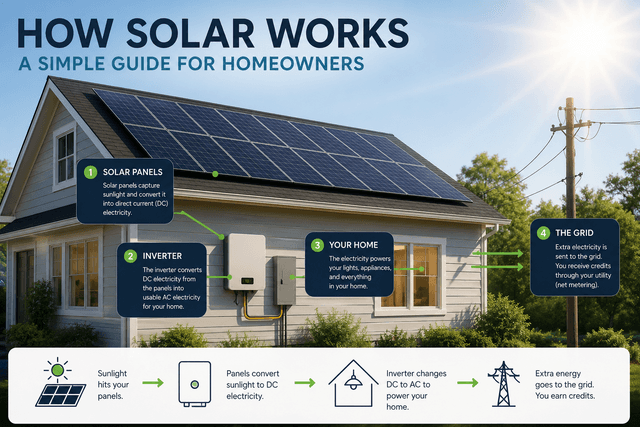
Compare south-, east- and west-facing roof sections. Solar 101How does home solar work? →
Follow electricity from the panels through the home. Excess productionWhat is net metering? →
Learn what may happen to excess solar electricity.