Quick answer
A home EV charger can be planned with a new solar system or added to an existing one. The useful design starts with how far you drive, the vehicle’s energy use, the charging speed you need, when the car is usually parked and the home’s available electrical capacity. Solar can offset some or all of the electricity used for charging over time, but the car does not automatically run only on real-time solar production. Household demand, charging time, utility rates, export credits and optional battery storage all affect the result.
Installing a charger and solar at the same time can simplify planning, but “solar EV charger” is not one universal product. The solar array generates electricity, the home charger safely delivers electricity to the vehicle and the utility grid fills any gap when current solar production is not enough.
A strong proposal coordinates all three parts: the vehicle’s expected energy use, the solar production plan and the home’s electrical system.

How home EV charging works with solar
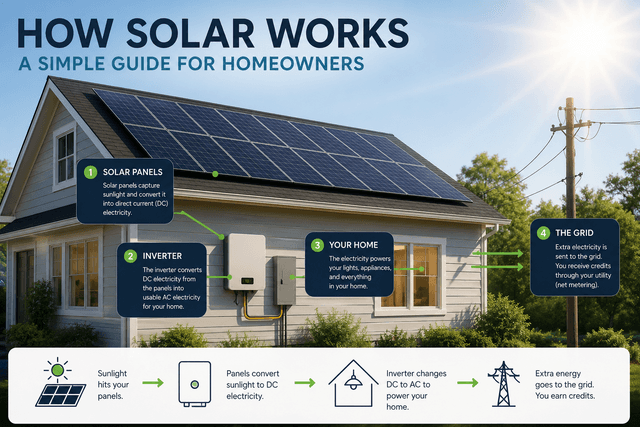
Solar panels produce electricity when sunlight is available. The home uses that electricity across its active loads, which can include an EV charger. When the charger and other loads need more power than the array is producing, the home can draw the difference from the grid. When solar production exceeds current use, the extra electricity may be exported or stored, depending on the equipment and utility program.
Daytime charging
The charger may use current solar production, grid electricity or both, depending on the home’s other loads and solar output.
Night charging
The home generally uses grid electricity unless compatible battery storage supplies the charger.
Annual offset
A solar design can account for expected EV energy use even when charging and solar production occur at different times.
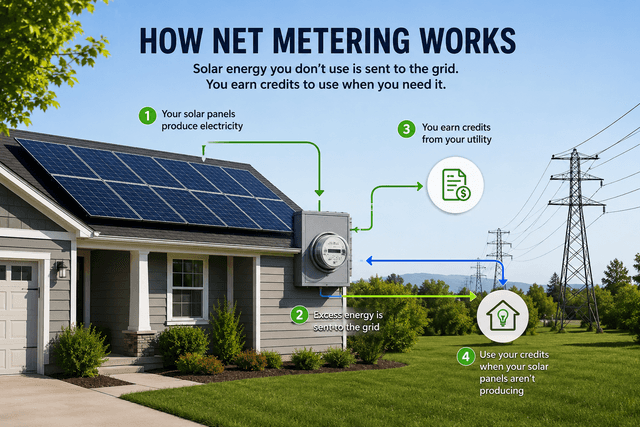
Whether exported electricity earns a credit, and how much that credit is worth, depends on the utility program. Review how net metering and solar credits work before assuming daytime exports and nighttime charging have equal value.
Level 1 vs. Level 2 charging at home
The U.S. Department of Energy’s Alternative Fuels Data Center describes two common residential charging approaches. Level 1 uses a standard 120-volt connection and adds energy more slowly. Level 2 uses a 240-volt circuit and charges faster, but it usually requires dedicated equipment and professional electrical planning.
| Charging option | Typical home setup | Best fit | Planning issue |
|---|---|---|---|
| Level 1 | 120-volt charging with a compatible cordset and receptacle | Lower daily mileage and long parking windows | Confirm the receptacle and circuit are suitable for continuous charging |
| Level 2 | 240-volt charging equipment on a properly designed circuit | Faster routine charging, longer commutes or more than one EV | Electrical capacity, breaker, wiring route, charger power and permits |
The vehicle, charger and circuit can each limit charging speed. A charger with a high advertised output will not charge faster than the vehicle can accept, and the electrical design must support the selected setting. A qualified professional should evaluate the home rather than choosing charger power from the product label alone.
Why plan the charger and solar system together?
Adding an EV can materially change household electricity use. If the vehicle is not included in the solar design, the array may be sized around historical consumption that does not reflect future charging.
- One energy-use forecast. Driving distance and vehicle efficiency can be translated into expected annual charging demand.
- One electrical review. The team can evaluate the main panel, service capacity, circuit route and equipment locations as one coordinated scope.
- Cleaner construction planning. Conduit, wiring paths and wall locations can be resolved before finished surfaces or solar equipment limit the options.
- One view of utility rules. Solar interconnection, charging rates, off-peak periods and available utility programs can be considered together.
- Room for future changes. A second EV, longer commute or higher-power charger can be discussed before the design is finalized.
Coordinated planning does not guarantee that every piece of work can be combined into one permit, crew visit or payment. The exact scope depends on local requirements, installer responsibilities and the home’s condition. Ask the proposal to state what is included and who completes each part.
Estimate the EV’s electricity use before sizing solar
The useful input is not simply “one electric car.” Two households with the same vehicle can use very different amounts of charging energy.
Bring these numbers to the design conversation
- Average miles driven per day, week and year
- The vehicle’s kWh-per-100-miles rating or recent charging history
- How often charging occurs away from home
- The hours the vehicle is usually parked at home
- Expected changes in commute, household vehicles or annual mileage
Charging losses and seasonal driving conditions should also be considered. The system designer can then estimate annual EV energy use and evaluate it alongside the home’s existing consumption and available roof area.
For the detailed sizing calculation, use Trinity’s separate guide to how many solar panels may be needed to charge an EV.
Check the home’s electrical readiness
A Level 2 charger is a significant continuous electrical load. Installation planning should address the service and panel, available breaker space, circuit length, conductor size, charger setting, equipment location and applicable permits.
Panel and service capacity
A load calculation helps determine whether the existing electrical system can support the proposed charger or needs another design approach.
Distance and routing
Long or difficult wiring routes, finished walls, detached garages and trenching can add labor and materials.
Hardwired or plug-in
The equipment instructions, location, circuit and local code help determine the suitable connection method.
Indoor or outdoor location
Cable reach, weather rating, physical protection, drainage, Wi-Fi and parking position all affect placement.
Do not use an extension cord or improvised adapter to solve a location or capacity problem. Follow the vehicle and charger manufacturer instructions and use qualified installation professionals.
Choose a charging schedule that fits the utility plan
Charging at noon may use more real-time solar. Charging overnight may fit the household routine or qualify for a lower off-peak utility rate. The better schedule depends on the utility tariff, export-credit value, vehicle availability and equipment controls.
| Charging goal | What to review | Tradeoff |
|---|---|---|
| Use more current solar production | Daytime parking, other home loads and solar output | The vehicle may not be home during the strongest solar hours |
| Use an off-peak utility rate | Eligible hours, rate enrollment and charging controls | Off-peak hours may occur when solar is not producing |
| Be ready by departure time | Required energy, charger power and available hours | A lower-power schedule may not replace a long day’s driving overnight |
Smart charging features can help set start times, limit charging power or coordinate charging with a rate plan. Confirm which controls come from the vehicle, which come from the charger and whether an ongoing network fee applies.
Do you need a home battery to charge an EV with solar?
No. A grid-connected home can charge an EV without battery storage. Solar can reduce the home’s grid electricity use or create utility credits during the day, while the vehicle may charge at another time.
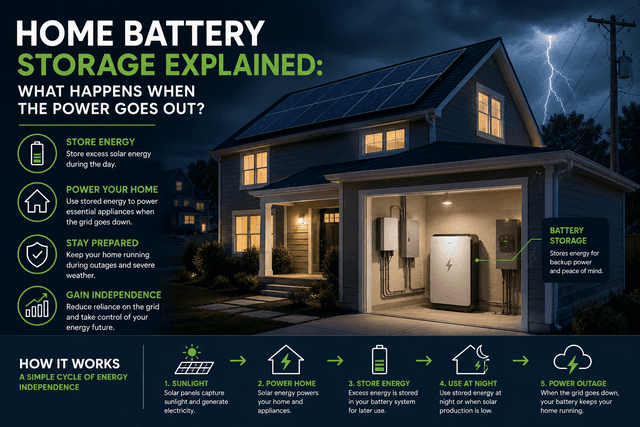
A battery can shift stored energy into evening hours or provide selected backup functions, but it adds cost and has finite energy and power. EV charging is a large load, so a battery that supports lights, refrigeration and outlets may not be designed to charge a vehicle during an outage.
Ask whether the proposed equipment allows EV charging when the grid is down, at what power, for how long and under which battery settings. Do not assume that having solar, a battery and a charger automatically enables that outcome. See how solar battery backup works and what limits runtime.
How much does a home EV charger installation cost?
The final cost combines the charging equipment and the electrical installation. A 2026 U.S. Environmental Protection Agency consumer guide lists typical Level 2 equipment at about $400 to $1,000 and installation at about $300 to $2,000, while noting that higher amperage, longer panel distance, difficult locations and electrical upgrades can increase the price.
Those figures are planning ranges, not a Trinity quote. A complete proposal should identify the charger, maximum configured power, connection method, circuit work, permits, electrical upgrades, warranty and any network or subscription cost.
Local utility or state charger programs may exist, but availability, eligibility, equipment lists and application timing can change. Verify the current program directly and ask whether approval is required before purchase or installation.
Questions to ask before approving the project
- How much annual electricity should be added to the solar model for the EV?
- Is Level 1 or Level 2 charging appropriate for the driving schedule?
- What charging power will the vehicle, charger and circuit actually support?
- Does the existing panel and service have enough capacity?
- What wiring, trenching, wall work, permits and electrical upgrades are included?
- Should charging be scheduled around solar production or the utility rate plan?
- Which smart features, warranties and network fees apply?
- What changes if a second EV, battery or higher-power charger is added later?
Design around the driving routine
The best system is not necessarily the highest-power charger or the largest solar array. It is the combination that replenishes the vehicle on schedule, fits the home’s electrical capacity and uses the utility plan effectively.
The bottom line
Home EV charging and solar work well together when the design accounts for real driving energy, charging hours, electrical capacity, solar production and utility rules. Planning them at the same time can reduce missed assumptions and make future expansion easier.
Start with the vehicle and routine, not a charger model. Then compare a written scope that covers solar sizing, charger power, electrical work, permits, controls, warranties and total installed cost.