Quick answer
Solar can lower an electric bill by reducing the electricity a home buys from the grid and, where the utility program allows it, creating credits for electricity sent back to the grid. The result depends on the home's electricity use, system production, utility rates, export-credit rules, fixed charges and the solar payment arrangement. A well-designed system can reduce utility costs, but homeowners should not assume every electric bill will fall to zero.
The most useful savings plan begins with the bill itself. Before comparing solar proposals, identify how many kilowatt-hours the home uses, when that use changes, which charges can be reduced and which charges may remain.
Then compare the proposed system's expected production and total solar payment with the utility costs it is intended to offset. That creates a home-specific decision instead of relying on a universal savings percentage.

How solar changes an electric bill
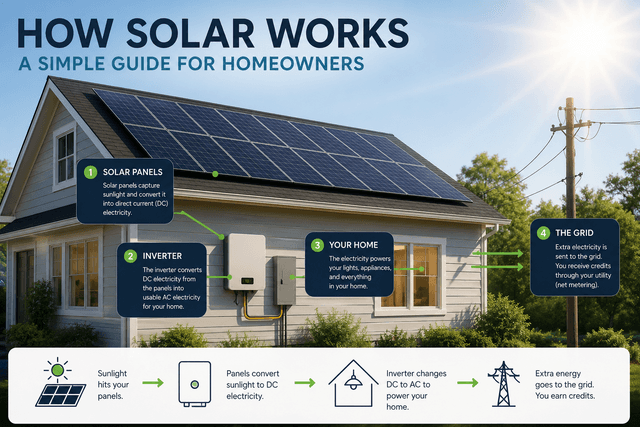
A grid-connected solar system affects the bill in two main ways. First, the home can use electricity the panels are producing at that moment. Every solar kilowatt-hour used on site is a kilowatt-hour the home does not need to buy from the utility at that time.
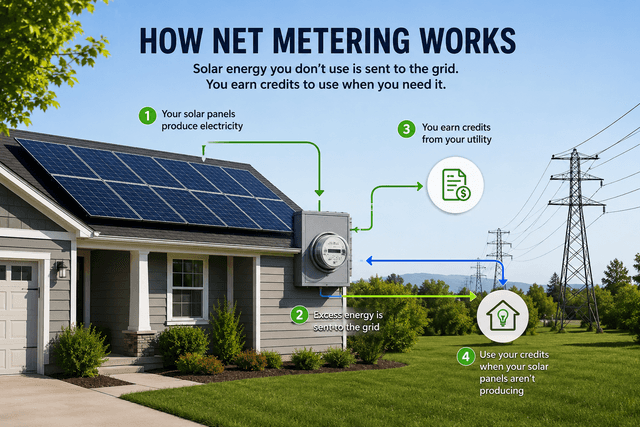
Second, solar production that exceeds the home's current demand may flow to the grid. The utility may apply a credit under its current distributed-energy or net-metering rules. Credit values, eligible charges, rollover rules and settlement periods vary by utility and program.
Use solar at home
Current solar production serves active household loads before the home buys the remaining need from the grid.
Export extra production
Unused solar electricity may earn a utility credit, but the credit is determined by the applicable tariff.
Buy electricity when needed
The grid supplies the difference when the home needs more power than the system is producing.
Because utility programs are not uniform, review how net metering and solar credits work before treating exported electricity as equal in value to electricity purchased from the grid.
Why might an electric bill remain after going solar?
Solar reduces specific parts of a utility bill. It does not necessarily remove every charge or every month of grid use.
| Reason a balance remains | What it means | What to verify |
|---|---|---|
| Fixed or minimum charges | Some utility charges apply even when net grid usage is low. | Customer, meter, delivery and minimum-bill terms |
| Grid electricity use | The home may buy electricity at night, during low-production periods or when demand exceeds solar output. | Imported kWh, billing period and seasonal use |
| Credit rules | Exports may not offset every charge or may be credited at a different rate. | Export value, rollover, expiration and annual settlement |
| Higher household use | An EV, heat pump, addition, pool or changed routine can push use above the design assumption. | Current use versus the baseline used in the proposal |
| Separate solar payment | A loan, lease or power purchase agreement may replace part of the utility expense with another payment. | Payment amount, rate, escalation, term and total cost |
Judge savings by comparing the combined utility and solar costs with the cost of staying with utility electricity—not by looking only at the lower utility bill.
Start with 12 months of electricity use
One bill cannot show a home's full energy pattern. Cooling, electric heating, holidays, vacations and changing daylight can make monthly use vary substantially. Gather at least the most recent 12 months of kilowatt-hour usage and costs when available.
Separate the inputs
- Electricity use: kWh consumed during each billing period
- Energy price: the rate or rates applied to purchased electricity
- Delivery and fixed charges: items that may respond differently to solar
- Rate structure: flat, tiered, seasonal or time-of-use pricing
- Planned changes: an EV, heat pump, home addition, pool or household-size change
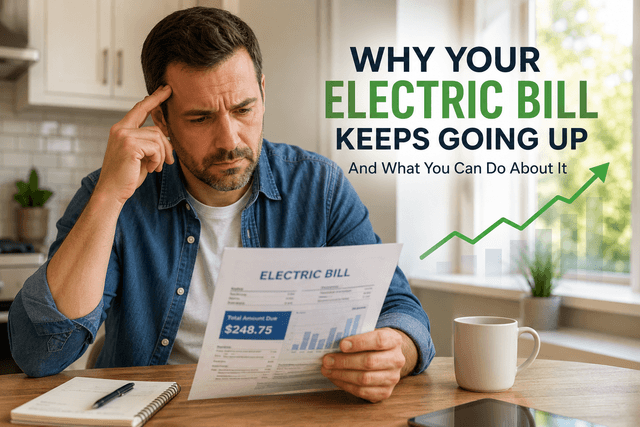
If the bill increased recently, identify whether the cause was a higher rate, higher usage or both. Trinity's guide to why electric bills rise covers that diagnosis in more detail.
Compare solar proposals using the same savings assumptions
A proposal should connect system size to estimated annual production and the home's expected electricity use. It should also disclose the assumptions used to translate production into dollar savings.
- Estimated annual production. Ask for projected kWh, the modeling source and the assumptions for roof direction, tilt, shade and system losses.
- Expected utility offset. Confirm how much of the home's annual use the design is intended to address and whether local rules limit system sizing.
- Utility-rate assumptions. Ask which current rate, export credit and future escalation assumptions appear in the model.
- Solar payment. Compare cash price, loan terms, lease terms or PPA price on the same time horizon.
- Items not included. Identify fixed utility charges, roof work, electrical upgrades, maintenance responsibilities and other project costs.
Production estimates are models, not guarantees. Weather changes from year to year, and actual results also depend on shade, equipment, system availability and household conditions. Ask for a conservative explanation of the inputs rather than accepting one large lifetime-savings number without the supporting math.
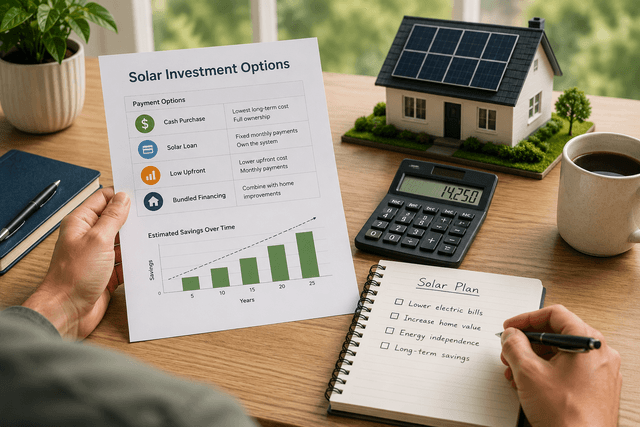
Use the separate solar payment-options guide to compare ownership, financing and third-party arrangements before deciding which structure fits the household.
Use less electricity before and after solar
Solar and energy efficiency solve different parts of the same cost problem. Solar changes where some electricity comes from. Efficiency reduces the amount the home needs in the first place.
Find major loads
Review heating, cooling, water heating, pool equipment, EV charging and other large or long-running electrical loads.
Correct waste first
Air sealing, insulation, equipment maintenance and appropriate controls may reduce energy use and improve comfort.
Plan new electric loads
Tell the solar designer about expected electrification so a lower historical baseline does not hide future demand.
Track use after installation
Continue watching household consumption; solar production does not prevent usage from increasing.
The U.S. Department of Energy describes a home energy assessment as a way to understand the whole picture of a home's energy use, comfort and safety. A professional assessment can help prioritize improvements when the cause of high usage is unclear.
Match flexible electricity use to the rate plan
Some households can improve the value of solar by changing when flexible loads run. The right schedule depends on whether using current solar production, earning an export credit or buying off-peak grid electricity is more valuable under the utility tariff.
- Schedule an EV, water heater, dishwasher or laundry during favorable hours when equipment and household routines allow.
- Avoid creating a new peak demand period if the rate includes demand-based or time-of-use charges.
- Confirm whether exported solar earns the full retail rate, another value or no rollover beyond a settlement date.
- Use manufacturer-approved timers and controls; do not compromise comfort, food safety or equipment instructions to chase a rate window.
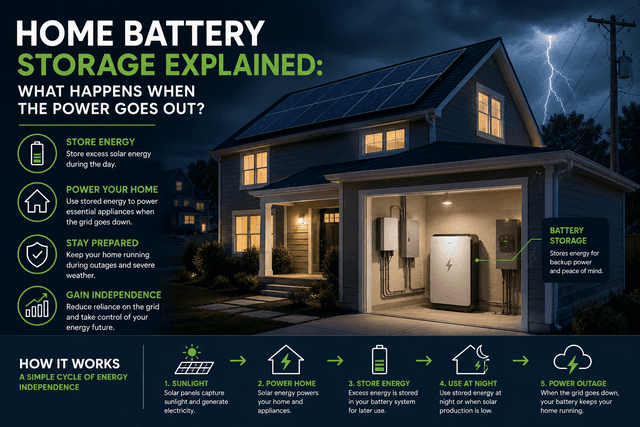
A battery may shift some stored energy into later hours, but it is not automatically a bill-saving requirement. Battery efficiency, usable capacity, control settings, tariff structure, incentives and total installed cost all affect the economic result.
Review results over a full year
Solar production and household demand are seasonal. A low-production winter month does not by itself prove that the design is underperforming, just as a high-credit spring month does not show the complete annual result.
Compare complete billing periods and, when possible, rolling 12-month totals. Track:
- Solar production shown by the monitoring platform
- Electricity imported from and exported to the grid
- Household electricity use, including new loads
- Credits carried forward, applied or settled
- Fixed charges and rate-plan changes
- The separate solar payment, if applicable
If production drops suddenly or remains below the expected seasonal range, check the monitoring system for alerts and contact the appropriate service provider. Do not climb onto the roof or handle electrical equipment to investigate.
Questions to ask before relying on a savings estimate
- Which 12 months of electricity use were included?
- How many annual kWh is the system expected to produce?
- What shade, weather, orientation and system-loss assumptions were used?
- Which utility rate and export-credit rules are reflected?
- Which utility charges are expected to remain?
- How are future rate increases modeled?
- What is the full solar payment and does it change over time?
- How would an EV, heat pump or other planned load change the result?
Compare the complete energy cost
A lower utility bill is only one line in the decision. Compare utility charges, solar payments, expected production, credit rules and planned household use on the same timeline.
The bottom line
Solar can reduce the amount of electricity a home buys from the utility, but savings are specific to the home, system, tariff and payment arrangement. The strongest plan starts with a year of usage, separates reducible charges from charges that may remain and tests every proposal against the same assumptions.
After installation, keep monitoring both production and consumption. Solar performs one side of the equation; efficient energy use and a well-matched utility plan help control the other.