Quick answer
Net metering is a utility-billing arrangement that can credit a solar customer for eligible electricity sent from the home to the grid. Those credits may offset electricity the home uses from the grid later. Credit values, rollover rules, fixed charges and eligibility vary by state, utility and program, so the applicable tariff matters as much as the amount of electricity exported.
Solar panels and household electricity use do not always peak at the same time. A system may produce more electricity than the home needs around midday, then produce less than the home uses in the evening. A grid-connected system manages that difference by serving the home first and interacting with the utility grid when production and usage do not match.
Net metering affects how the utility accounts for eligible electricity that leaves the property. It does not mean the utility stores the homeowner’s electricity, and it does not guarantee a cash payment, a zero-dollar bill or backup power during an outage.

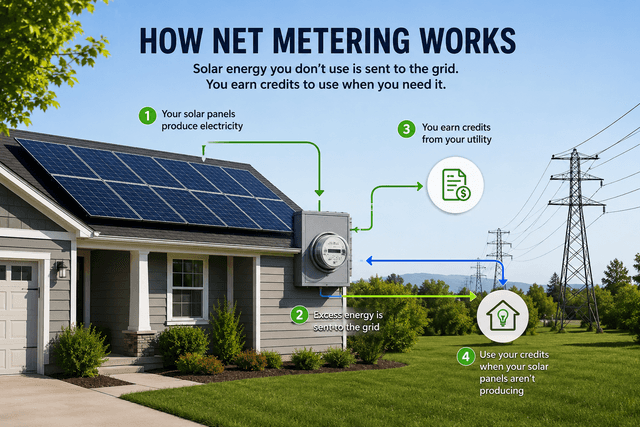
How net metering works
01
Solar produces electricity
The panels generate electricity when sunlight is available.
02
The home uses solar first
Current household demand is served before eligible excess electricity is exported.
03
Excess may reach the grid
A bidirectional meter records qualifying electricity sent to the utility system.
04
The bill applies program rules
The utility calculates credits and charges under the customer’s current tariff.
When solar production is lower than the home’s demand, the home can draw electricity from the grid as usual. The utility bill then reflects imported electricity, eligible exports, applicable credits and charges according to the customer’s program.
A solar-production estimate is most useful when it compares expected annual generation with the home’s actual annual electricity use. Learn how system output is estimated in our guide to how much power solar panels produce.
Self-consumption and exported electricity are different
Electricity used inside the home at the moment it is generated is called self-consumption. That electricity serves household demand directly and does not need to be purchased from the grid at that moment.
Exported electricity is the eligible excess that moves beyond the home’s meter to the grid. The utility determines how that exported electricity is measured and credited. These two forms of value should not be treated as interchangeable because the price of imported electricity and the value assigned to exports may differ.
| Electricity flow | What happens | How value is determined |
|---|---|---|
| Solar used immediately | Serves the home’s current demand | Avoids buying that electricity from the grid at that moment |
| Solar exported to the grid | Is measured as eligible exported electricity | Receives the credit defined by the current program or tariff |
| Electricity imported from the grid | Supplies demand not met by current solar production | Is billed under the customer’s applicable utility rate |
Bill credits are not automatically cash
Many programs apply credits to an electric account rather than sending a cash payment. Rules for unused credits, annual reconciliation and account transfer vary. Review the utility’s current written terms instead of assuming every kilowatt-hour has the same value.
What changes by state and utility?
“Net metering” is often used as a broad label, but actual programs can differ in ways that materially affect a homeowner’s bill. Some states or utilities use net billing, export-credit programs or another compensation structure instead.
Credit value
The rate or formula applied to exported electricity.
Rollover and reconciliation
Whether unused credits carry forward, reset or receive another treatment.
Fixed and non-bypassable charges
Charges that may remain even when energy credits reduce usage-related costs.
System eligibility
Size limits, equipment rules, customer class and application requirements.
Interconnection
The review, meter and authorization required before normal grid-connected operation.
Future policy changes
Whether existing participants keep earlier terms or move to updated rules.
Massachusetts example
Massachusetts describes net metering as a process that lets eligible customers offset electricity use and transfer electricity back to the electric company in exchange for bill credits. Eligibility, credit treatment, system classification and program capacity depend on current state rules and the customer’s electric company. Homeowners should verify the tariff and program terms that apply to the proposed system rather than relying on a statewide rule of thumb.
New Jersey example
New Jersey provides net-metering pathways for eligible customer-generators, but participation still requires utility interconnection and compliance with the applicable program and tariff. The electric company’s current documents control how exports, credits and annual accounting are handled for a specific account.
These examples show why a national explanation cannot promise one credit rate or billing result. The right question is not only “Does my state have net metering?” It is “Which current utility program would this home enter, and how would that program value eligible exports?”
Net metering vs. battery storage
Net metering and battery storage both address the mismatch between solar production and household demand, but they do different jobs.
| Question | Net metering | Battery storage |
|---|---|---|
| Where does excess solar go? | Eligible excess is exported to the grid | Compatible excess can be stored at the home |
| What value does it provide? | Utility-bill credits under the applicable rules | Stored electricity for later home use |
| Does it provide outage power? | No | Only when compatible equipment is designed and configured for backup |
| What controls the result? | Utility program, tariff, meter and exported electricity | Battery capacity, power rating, protected loads and system configuration |
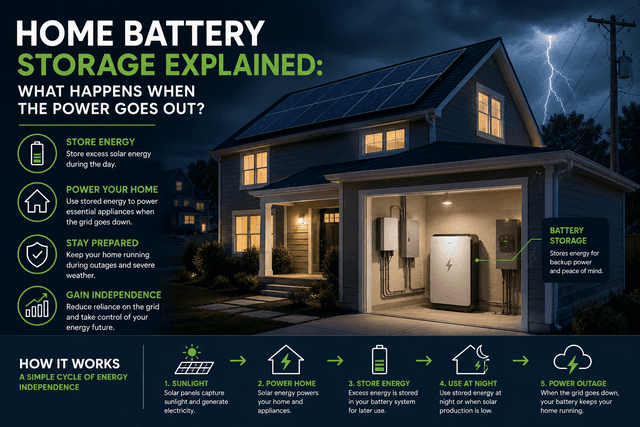
A grid-connected solar system generally shuts down during an outage to help protect utility workers and equipment. Solar panels alone do not provide backup power. A compatible battery and properly configured backup system are typically required to power selected home loads during an outage. Explore solar and battery storage options.
How net metering affects solar-system sizing
A larger system does not automatically create a better financial result. The useful system size depends on the home’s electricity use, roof and solar exposure, program limits, export-credit rules and the homeowner’s goals.
If exports receive a different value than electricity used immediately, self-consumption patterns can matter. Planned changes such as an electric vehicle, heat pump, addition or major appliance may also change future demand. That is why a system recommendation should be tied to actual usage and a documented production estimate—not square footage alone.
Start with 12 months of electricity use and review our homeowner guide to how many solar panels a home may need.
A sound savings estimate connects four inputs
- The home’s current and expected electricity use
- The proposed system’s estimated annual production
- The utility’s current import rates and export-credit rules
- The project’s payment, ownership and contract terms
What to verify before relying on net-metering savings
- Program name: Confirm the exact tariff, rider or export-credit program for the property.
- Credit value: Ask how eligible exports are valued and whether that value changes by time, season or program.
- Credit treatment: Verify rollover, expiration, annual reconciliation and any payment rules.
- Remaining charges: Identify fixed, minimum, delivery or other charges that credits may not offset.
- Eligibility and limits: Confirm system-size rules, application requirements and available program capacity.
- Interconnection timeline: Understand what the utility must approve before Permission to Operate.
- Written assumptions: Make sure the proposal identifies the utility rate and credit assumptions used in the savings estimate.
Utility approval is one stage in a larger project. See the full solar installation process from consultation through Permission to Operate.